
The verdict
Meetup is worth it if there is an active, small, recurring group near you that matches something you already like doing. It is not worth it as a place to browse, and it is rarely worth paying for until you have been to a few events and know you'll keep going. The app itself is free to download. The value lives entirely in the specific group you pick.
That is the honest version most reviews skip. Meetup is not one experience. A weekly 12-person hiking group and a 300-RSVP networking mixer are both ‘Meetup’, and they produce completely different results.
What it does well
Meetup's App Store description says you can find local or online events by category, keyword or map, message members directly, and start your own group. It says it has over 60 million members, and the US app holds a 4.7 rating from about 273,000 ratings. In a decent-sized city, that means there is usually a group for almost anything: trail running, Spanish practice, board games, startup founders, knitting.
Its real strength is repetition. University of Kansas researcher Jeffrey Hall found it takes about 50 hours together to become casual friends and more than 200 to become close friends. You will not get there at one-off events. A group that meets every week puts you in the same room as the same people, which is how those hours add up.
Where it falls short
Group quality varies wildly, and the listing doesn't always tell you. Some groups have thousands of members and haven't held an event in months. Big events are hard to crack alone, because regulars arrive together and stay together.
It also depends on where you live. Smaller towns may have a handful of groups, and the one that fits you may not exist yet. And the app sells several subscriptions, which aren't clearly explained in the store listing.
What it costs
Downloading and browsing is free. The US App Store lists a stack of in-app purchases: ‘Meetup Plus Subscription’ entries at $4.99 and $9.99, a Member Subscription at $9.99, a 1-Month Unlimited Subscription at $14.99, Standard Organizer at $12.99, and a 1-month Meetup Subscription at $23.99. Most of those entries don't say whether they bill weekly, monthly or yearly.
So before you pay, open the subscription screen in the app and check two things: the billing period, and exactly what it unlocks that you'd use this month. If the answer is ‘nothing I need to get to Thursday's event’, skip it for now. Check each event page for a fee too, so nothing surprises you at the door.
How to tell if a group is worth your evening
Spend five minutes on the group page before you RSVP. You're looking for signs that real people show up regularly.
How to go to a social event alone
- Past events: at least three in the last two months. A big member count with no recent events is a dead group.
- Size: 8 to 25 people going. Small enough that you'll talk to most of them, big enough that it doesn't hinge on one person.
- Same format each time: ‘every Tuesday, same bar’ beats a different venue and theme every week.
- An activity: a run, a game, a hike or a class gives you something to talk about. Pure mixers make you do all the work.
- Photos and comments from recent events with the same faces in them. That is a group with regulars, which is what you want to become.
Give it three visits, then decide
One event tells you almost nothing. The first time, you're the new person. The second time, someone says ‘oh, you came back’. By the third, you have a name or two and a reason to message someone. Judge Meetup after three visits to the same group, not after one awkward mixer.
At the second or third event, make one small move: ‘A few of us are grabbing food after, want to come?’ or ‘Are you going next week? I'll save you a spot.’ The group gets you in the room. That sentence is what turns a regular into a friend.
Where HMU is different, and where it falls short
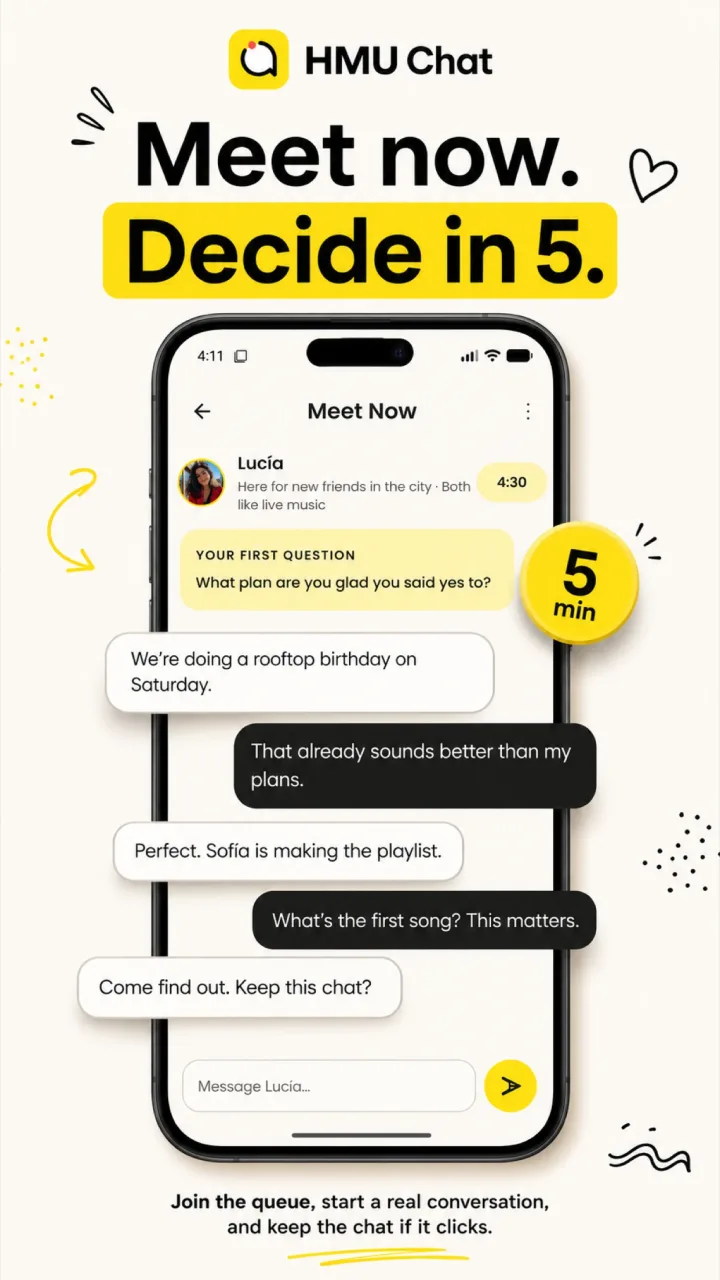
HMU solves a different problem. It isn't an events app and it doesn't run groups. It's for adults 18+ who want to talk to someone new without planning an evening around it. Meet Now pairs you with one person for a five-minute chat that starts with the same opening prompt for both of you. Each of you privately chooses Keep or Pass, and the chat carries on only if you both choose Keep. HMU is free on iPhone and Android, the free tier gets 3 Meet Now introductions a day, and HMU Premium is optional.
Where HMU falls short next to Meetup: it's one-to-one, so it won't put you in a weekly room with the same 15 people, and it has no events or groups. People also use it for friendship, dating or both, so say what you're after. You can report or block anyone.
Who should pick which
Pick Meetup if you have an evening a week to give, you like doing things more than talking about them, and there's an active group within easy reach. Pick HMU if your schedule is unpredictable, you'd rather start with one conversation than a crowd, or your area's Meetup listings are thin. Plenty of people use both: a weekly group for repeat contact, a quick chat on the nights nothing is on.
Related articles
- Apps to Make Friends as an Adult: An Honest Comparison — BFF, Meetup, Timeleft, 222, Yubo, and HMU compared by how you actually meet people, what it costs, and who each one suits.
- Timeleft Review: Is It Worth It, and How HMU Compares — An honest Timeleft review from its own current pages: how matching works, the full cost, the no-show fee, and when HMU is the better first step.
- Is Bumble BFF Worth It? An Honest Review — In the US, BFF costs nothing, so the real cost is your time. Which BFF app you’re looking at, what you get, and a two-week test to find out if it works.
- Best Apps to Make Friends in a New City, by Week — Nextdoor, Meetup, BFF, Timeleft and HMU each fit a different stage of a move. Which to install first, what each costs, and who should skip which.