
The short answer
In a new city, run three apps, not ten: one for your block (Nextdoor), one for a weekly group (Meetup), and one for meeting individuals (BFF by Bumble for friend matching, or HMU if you’d rather talk to someone tonight). Add Timeleft if you want someone else to plan an evening with strangers and you’re happy to pay for it.
The order matters more than the pick. Each app does a different job at a different point in a move, and most newcomers install everything in week one, then quietly stop opening all of it by week three.
Why apps matter more after a move
Most adults don’t meet close friends online. In a 2021 American Perspectives Survey, 40% of Americans with close friends met one through friends they already had, and 35% met one in their neighborhood. After a move, you have neither yet. Apps are a stand-in for the network you left behind until you build a new one.
They also have to produce hours, not just matches. University of Kansas researcher Jeffrey Hall studied 355 adults who had moved in the past six months and found a casual friendship takes roughly 40 to 60 hours together. Time spent hanging out counted more than time spent working side by side. So judge each app by one question: does it lead to repeated time with the same people?
Week one: Nextdoor, for the people on your street
Nextdoor describes itself as a neighborhood network: local news, safety notices, recommendations, buy-and-sell listings and events, plus a push to turn shared interests into real-life connections. It’s the only app here built around your address, which makes it the fastest way to stop being anonymous where you live.
Use it for small, specific asks that create a second meeting. Posting ‘New to the block, where’s the best bagel?’ gets replies. Picking up a free bookshelf from a neighbor gets you a face you’ll see again.
Skip it if: you want friends who share your interests rather than your zip code.
Weeks two to eight: Meetup, for one weekly anchor
Meetup says membership is free, and anyone can start a group to host events. It’s where you find the recurring things that build Hall’s hours: run clubs, language exchanges, board game nights, hiking groups. Pick one that meets weekly and has photos from recent events, and go four times before deciding.
Skip it if: your city’s listings are thin or mostly sales pitches. Check each event page for any cost before you RSVP. If nothing fits, start the group you were looking for.
Any time: BFF, for friend matching without the dating question
BFF by Bumble is the friendship-only option. Its App Store listing says every match has passed selfie verification, you can build community in Groups, and every feature is free with no paywalls or locked features. It’s rated 18+.
It suits newcomers who like to message for a few days before meeting. The weak spot is the one every matching app shares: chats stall at ‘how’s your week’. Put your move in your bio, then send a plan within a few messages.
Skip it if: you know you never reply to matches. Another inbox won’t change that.
- Bio line: ‘Moved here from Denver in September. Looking for a Saturday hiking buddy and someone to try the taco places with.’
- Third message: ‘I’m going to the farmers market Sunday at 10. Want to meet at the coffee stand?’
One night out: Timeleft, when you want strangers at a table
Timeleft has you take a personality quiz, book an experience, and find out the venue on the day. Dinners run every Wednesday in groups of four to six, women-only dinners every Tuesday at 7pm, and there are coffee meetups on Saturday afternoons and group runs. It says it runs in more than 200 cities in 52 countries. The app is free to download, the US App Store lists Timeleft X purchases at $19.99, $46.99 and $62.99, and you pay for your own food and drinks.
It’s the best pick for the evening you dread most: the empty Wednesday in month one. Skip it if money is tight or you want to see the same people every week. Each table is new, so if you click with someone, get their number before dessert.
Tonight: HMU, for one real conversation
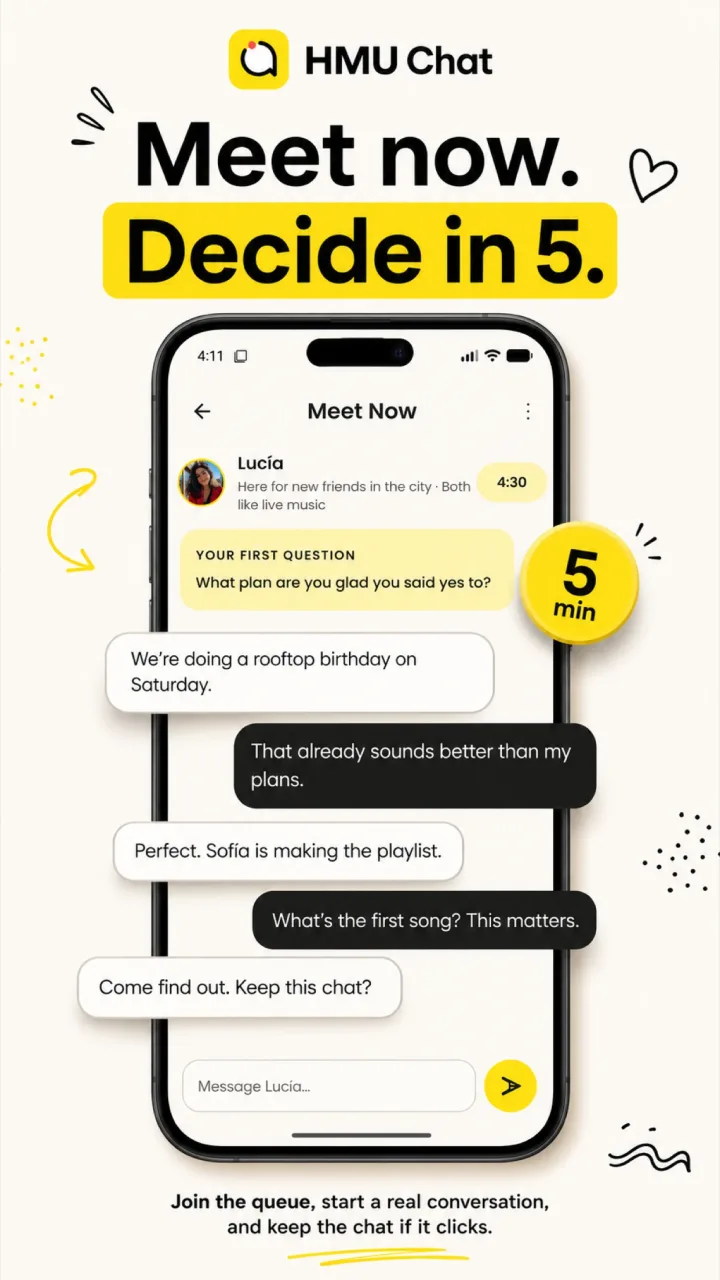
HMU, for adults 18+, is built around talking rather than browsing. Meet Now pairs you with one person for a five-minute chat that starts with the same opening prompt for both of you. Each of you privately chooses Keep or Pass, and the chat continues only if you both choose Keep. Discover has a Nearby tab for finding people around your new place, and every request starts with a real first message. HMU is free on iPhone and Android, with 3 Meet Now introductions a day on the free tier and optional HMU Premium. It has passed 500,000 downloads.
It fits the evenings when you’re home, unpacked and bored, and you’d rather have a real conversation than scroll.
Where HMU falls short
HMU is one-to-one. It doesn’t run groups or events, so it won’t give you the weekly anchor a Meetup group or a Timeleft table can. It isn’t friendship-only either: people use it for friendship, dating, or both. If you want to be certain everyone is there for friends, BFF is the clearer choice. On HMU, say what you’re after early, and report or block anyone who ignores it.
Who should pick which
Choose by the gap you feel most right now, then add a second app only when the first one is producing plans.
How to make friends in a new city
- You don’t know a single neighbor: Nextdoor.
- You want the same faces every week: Meetup.
- You want friends only, and you like to message first: BFF.
- You want a planned night out and don’t mind paying: Timeleft.
- You want to talk to someone tonight without writing an opener: HMU.
- You haven’t unpacked yet: none of them. Start with the general new-city plan.
Related articles
- Apps to Make Friends as an Adult: An Honest Comparison — BFF, Meetup, Timeleft, 222, Yubo, and HMU compared by how you actually meet people, what it costs, and who each one suits.
- How to Make Friends in Your 40s: Start With Who You Know — Midlife is when loneliness peaks. How to make friends in your 40s by reviving old ties, hosting, and finding people at your stage, with exact messages.
- How to Meet an Online Friend in Person (Safely) — How to bring up meeting, check they’re real, plan a safe first meetup, and handle the awkward first hour, so an online friend becomes a real-life one.
- How to Make Friends With Social Anxiety, One Step at a Time — A step-by-step way to make friends when meeting people scares you: a practice ladder, three lines to bring, and when to talk to a professional.