
Nerves, shyness, or something bigger
Lots of people get nervous meeting new people. Social anxiety disorder is something more specific. The US National Institute of Mental Health (NIMH) describes it as a common anxiety disorder built around fear of being judged or scrutinized, in situations like meeting new people. It can show up as blushing, sweating, trembling, or a racing heart, and as avoiding people or situations altogether. For a diagnosis, NIMH says the feelings must last at least six months and get in the way of daily life, such as work, school, or relationships.
This article can’t tell you which one you have, and you don’t need a label to use it. The steps below work for ordinary nerves and fit alongside professional help if you need it. If that description sounds like your life, the last section covers who to talk to.
Build a ladder, not a leap
The NHS suggests breaking difficult situations into smaller steps. For friendship, that means skipping the advice to ‘just go to a party’ and writing your own ladder instead: ten steps, from barely uncomfortable to genuinely hard. Start on the lowest rung you can manage this week, and repeat it until it feels boring. Boring is the signal to move up a rung.
Your ladder will look different from anyone else’s. Here is one example to adapt.
- 1. Reply to a post in an online group about a hobby you have
- 2. Ask a barista or librarian one question beyond the order
- 3. Go to a class where there’s a teacher and a task, and say hi to one person
- 4. Ask someone in that class a question about the class
- 5. Go back the next week and use their name
- 6. Text one person you already know and suggest a short coffee
- 7. Stay for ten minutes after the class ends
- 8. Invite someone from the class to something specific with an end time
Choose places where you have a job to do
Open-ended mingling is the hardest format there is: no script, no role, and no obvious way out. Pick settings where everyone has something to do and talking is optional. A volunteer shift sorting food donations, a pottery or language class, a board game cafe, a climbing gym, or a weekly run club all give you a task to focus on and a built-in topic. Silence feels normal when your hands are busy.
Go to the same thing every week. Recognition does a lot of the work for you. By the third week, people start the conversation because they’ve seen you before.
Bring three lines with you
Don’t rehearse a whole conversation. Prepare three lines: one to start, one to keep it going, and one to leave. Knowing how you’ll get out makes it much easier to get in.
What to say when a conversation goes quiet
- Start: ‘Is this your first time here too?’
- Start: ‘How long have you been coming? I’m still figuring out the rules.’
- Keep going: ‘What got you into this?’
- Keep going: ‘What would you tell someone on their first week?’
- Leave: ‘I’m going to grab some water. Good to meet you. See you next week?’
- Leave: ‘I need to head out, but I’m glad we talked.’
Don’t trust the replay
Many anxious people leave a conversation and replay it for hours, hunting for the awkward moment. That replay is a poor judge. In studies published in Psychological Science, people consistently underestimated how much their conversation partners liked them, both after brief chats with strangers and among college roommates, where the gap lasted for months. The researchers say people were so absorbed in worrying about what they’d said that they missed the other person’s signs of interest.
The NHS suggests focusing on what people are saying rather than assuming the worst, and keeping a diary of your thoughts in social situations. Try a short version tonight: write down three things the other person actually said or did, not what you think they thought. Over a few weeks, compare your predictions with what happened.
Start one-to-one, and use text as a warm-up
Groups mean more people watching and more conversations to track at once. One person at a time can feel much easier. Texting first also helps, because you get time to think before you reply. Use it as a warm-up, not a hiding place: once a text conversation is going well, suggest a short, specific plan with a clear end, like ‘Coffee on Saturday at 10? I’ve got about an hour.’
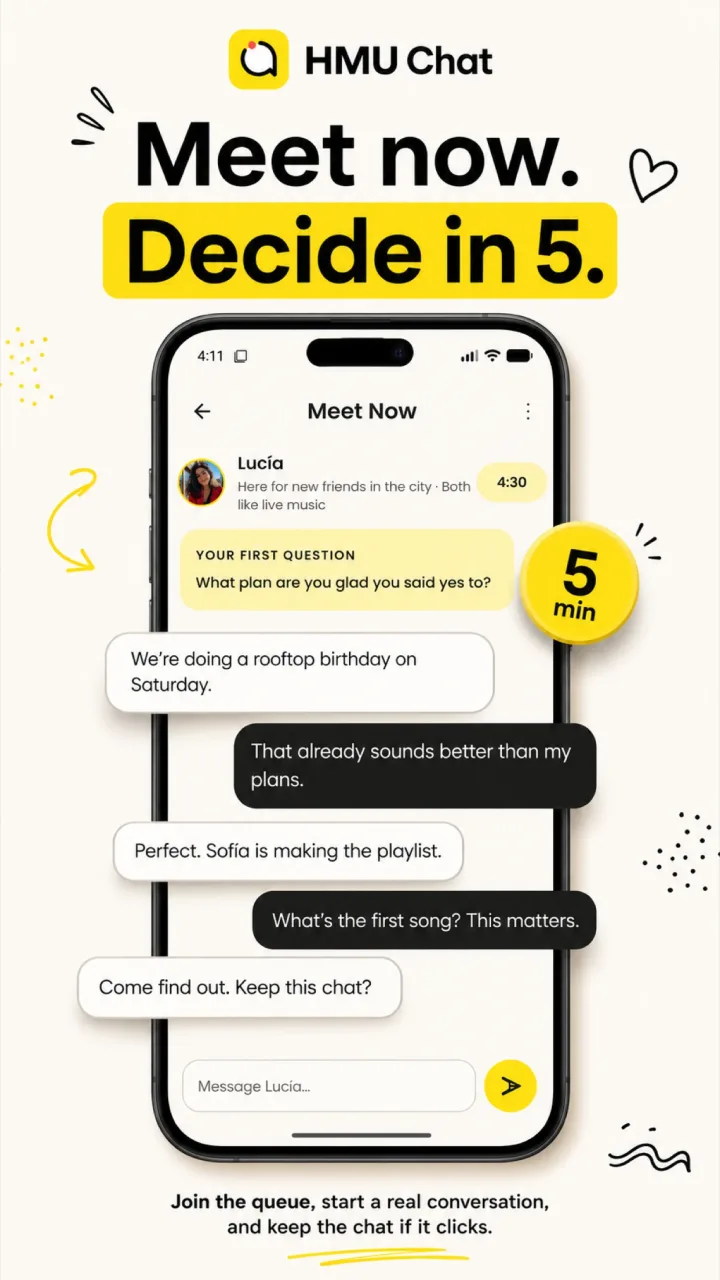
Some apps take the blank-page problem away. On HMU’s Meet Now, you’re paired with one person, and you both get the same opening prompt, so nobody has to come up with an opener. You talk for five minutes, then each of you privately chooses Keep or Pass, and the chat only continues if you both choose Keep. A conversation that isn’t working costs you five minutes. HMU is free for adults 18+ on iPhone and Android, with 3 Meet Now introductions a day on the free tier.
Count what you did, not how you felt
You may feel anxious through every step on the ladder, especially early on. That doesn’t mean the step failed. Measure progress by actions: you went, you said hello, you stayed ten minutes, you sent the text. Leaving a party after half an hour is still going to a party.
Watch for the quiet ways avoidance creeps back in: arriving late so you miss the chat before things start, always looking at your phone, or saying no to the second invitation because the first went fine and you don’t want to push your luck. Avoidance feels like relief today and makes the next step harder.
When to talk to a professional
If fear of judgment is stopping you from working, studying, or keeping relationships, or the steps above feel impossible, talk to someone. NIMH suggests starting with a primary care provider, who can refer you to a qualified mental health professional. In the UK, the NHS says to see a GP, and in England you can refer yourself to an NHS talking therapies service without a GP referral.
Treatment works for many people. NIMH says cognitive behavioral therapy (CBT) is commonly used to treat social anxiety disorder, alongside approaches like exposure therapy, and medication is an option. The NHS calls CBT generally the best treatment. Support groups help some people too, though NIMH notes they don’t replace a provider’s advice.
If you’re in the US and feeling overwhelmed or unsafe, you can call or text 988, or chat at 988lifeline.org. It’s free, confidential, and open 24/7, and you don’t have to be suicidal to reach out.
Related articles
- Apps to Make Friends as an Adult: An Honest Comparison — BFF, Meetup, Timeleft, 222, Yubo, and HMU compared by how you actually meet people, what it costs, and who each one suits.
- I Have No Friends. What Do I Do? Start Here — No friends right now? You’re not the only one. A practical two-week plan, what to say when you feel you have nothing to offer, and where to get support.
- How to Make Friends as a New Parent: Mom and Dad Friends — Where new parents actually meet each other, what to say at the playground, plans that fit nap time, and how to tell tiredness from something more.
- Go Together, Meet People Separately — Make an event-buddy plan that lets you arrive with a friend, join different conversations, reconnect, and leave without guessing each other’s expectations.