
What Timeleft does well
Timeleft solves the hardest part of meeting new people: making a plan with strangers. You take a quiz about your personality and social energy, add practical details like neighborhood, language, diet and budget, and Timeleft seats you at a table of four to six. The weekly dinner is on Wednesday. You learn the venue on the day, and you pay for your own food and drinks.
It has grown well beyond dinner. Timeleft's App Store listing also lists group runs followed by coffee, Saturday afternoon coffee, Women-Only Dinners on Tuesdays at 7pm, and Last Drinks after dinner in some cities. It says it runs in 52 countries. If it works in your city and Wednesday works for you, it is one of the easiest ways to sit down with strangers this week.
Why people look for something else
Most people who search for an alternative have one of four complaints. Knowing which one is yours narrows the list quickly.
- Cost: the US App Store lists Timeleft X purchases at $19.99, $46.99 and $62.99, and that is before the meal
- Schedule: the main dinner is on Wednesday, and you can't move it
- One night only: each table is a fresh group, so seeing anyone again is up to you
- Format: a three-hour dinner is a big first step if you'd rather start with a conversation
222: the closest swap
If you like the idea of a surprise group outing, 222 is the nearest alternative. It sends invites to group experiences in public places near you, chooses who attends based on your profile, and vets members before selecting them. If you aren't selected, you get a refund. There are no profiles, DMs or swiping, so you meet everyone in person.
Limits: 222 is iPhone only and needs iOS 18 or later. Its App Store listing doesn't give a price, so check the cost and whether it runs in your city in the app before you plan around it.
Meetup: when you want the same faces every week
Timeleft's biggest structural weakness is that every table is new. Meetup is the opposite. Groups form around a shared interest, such as a running club, a language exchange or a board game night, and the good ones meet weekly. Seeing the same people again and again is how acquaintances become friends. Meetup is free to download, and Meetup Plus subscriptions are optional.
Pick a small group with recent events and go three times before you judge it. If walking in alone is the hard part, plan your first ten minutes in advance.
BFF by Bumble: free, and you choose who you meet
Timeleft's algorithm picks your table. BFF lets you choose. You match with people based on hobbies, lifestyle and goals, start with a one-on-one chat, or join interest Groups that plan meetups. Bumble says every match has passed selfie verification and every feature is free.
The trade-off is the usual matching-app problem. Many matches never turn into a conversation. Send a specific invitation early, like ‘Trivia at the Fox on Thursday, want in?’, rather than chatting for a week.
HMU: start with a conversation instead
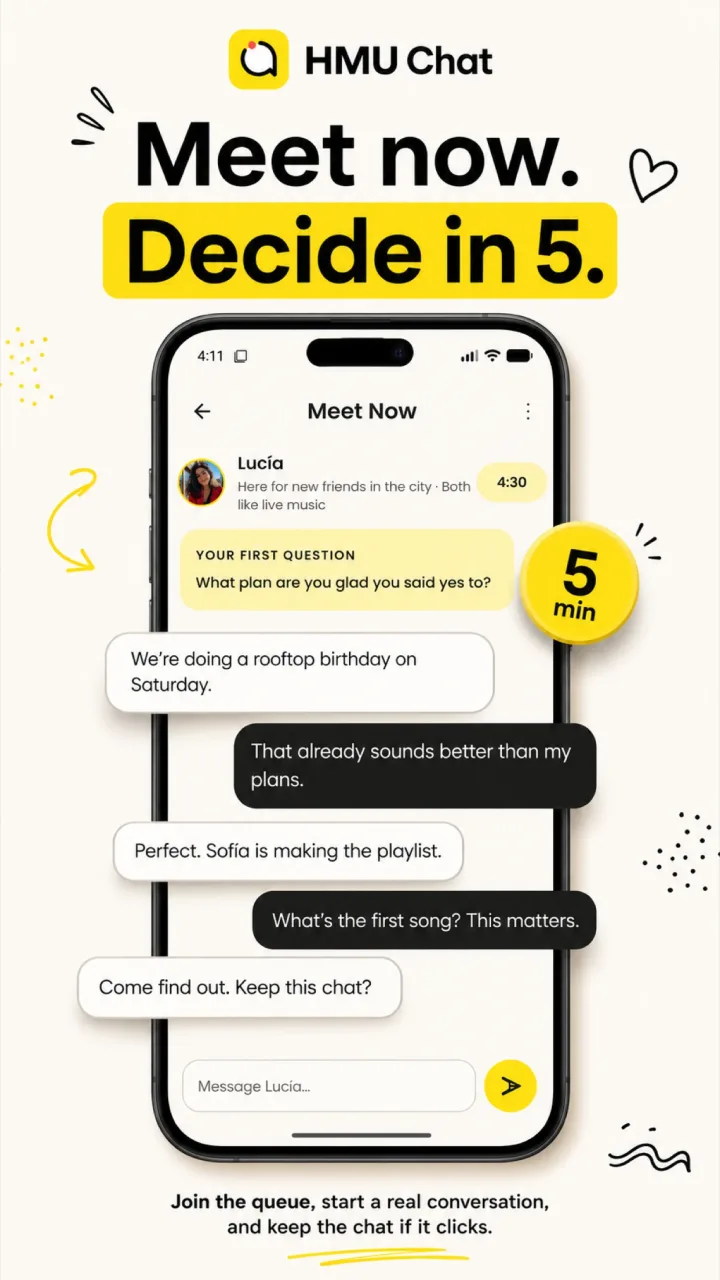
HMU is not a dinner app, and it won't seat you with anyone. It suits people who would rather find out whether they click with someone before committing to an evening. In Meet Now, HMU pairs you with one person for a five-minute chat, and you both start with the same opening prompt. Then each of you privately chooses Keep or Pass. The chat continues only if you both choose Keep, so you can suggest coffee to someone you already know you get along with.
Outside Meet Now, every request on HMU starts with a real first message, profiles have a question to answer, and there's a new question every day. HMU is free on iPhone and Android for adults 18+, with 3 Meet Now introductions a day on the free tier and optional HMU Premium.
Where HMU falls short
If what you love about Timeleft is the table itself, HMU won't replace it. HMU doesn't book venues, plan outings or put you in a group. Turning a good chat into a real meeting is up to the two of you. HMU also isn't friendship-only. People use it for friendship, dating or both, so say what you're after early in the conversation. Timeleft keeps those separate, with Singles events alongside its regular dinners.
Who should pick which
Stay with Timeleft if it runs in your city, Wednesday works, and the price is fine. Very little else gets you to a table of strangers with so little effort. Try 222 if you're on iPhone and want a curated in-person outing on a different schedule. Choose Meetup if you want a weekly habit with the same people. Choose BFF if you want a free, friendship-only app and like to chat before meeting. Choose HMU if you want to talk to someone tonight, from your couch, before deciding whether to meet.
Many people use two: one in-person format for repetition, and one conversation app for evenings when nothing is planned.
Make the second meeting happen
Whichever app you use, the first meeting is the easy part. Most new connections fade because nobody suggests a second plan. Before you leave a table, or right after a chat goes well, make one small, specific suggestion: ‘I'm going to the Saturday market at ten. Come along if you're free.’ It is easy to say yes to, and just as easy to turn down.
Related articles
- Apps to Make Friends as an Adult: An Honest Comparison — BFF, Meetup, Timeleft, 222, Yubo, and HMU compared by how you actually meet people, what it costs, and who each one suits.
- Apps Like Meetup for Making Friends — Meetup is great for weekly groups. These alternatives cover hosted dinners, friend matching, and live one-to-one chats, with costs and limits for each.
- Apps Like Wizz for Adults (18+ Only) — Wizz is built for young people and is open from age 16. If you're an adult who wants the same instant chat, these 18+ apps are a better fit.
- How to Make Friends in Your 30s: Find the Hours First — Friendship takes about 50 hours to get started. A practical plan for finding those hours in your 30s, with scripts for the invite most people never send.