
The 20s problem is churn, not a shortage of people
Your 20s aren’t short on new people. In the American Perspectives Survey, 56% of adults under 30 said they’d made a new friend in the past year, compared with 46% of all adults. The same survey found that 59% of young women had lost touch with at least a few friends over the same year.
That’s the real pattern. Friends arrive fast and leave fast. Roommates change, coworkers quit, someone moves for grad school, someone else moves in with a partner. Making friends in your 20s is less about finding people and more about getting a few of them to stick.
What changes around 25
In your early 20s, structure does most of the work: school, a first job with a cohort of people your age, shared apartments, a group chat that plans for you. By the middle of the decade, much of that has gone. Your weekdays belong to a job where you might be the only person under 30. Your college friends live in four different cities. Plans no longer happen unless someone makes them.
If you’re 25 and wondering why it suddenly feels hard, nothing is wrong with you. The setup changed. From here on, friendship needs a plan the way your career does.
Most friendships die at the second hangout
You meet someone at a party, have a great hour, follow each other, and never see them again. That’s the most common way friendships end in your 20s. Nobody rejected anyone. Nobody asked twice.
Communication researcher Jeffrey Hall at the University of Kansas estimated it takes about 50 hours together to go from acquaintance to casual friend and about 90 to become friends. Time spent hanging out and joking around counted most. Fifty hours never comes from one great night. It comes from the second, third and fourth plan. So make the second ask within a week, while the first one still feels recent, and make it specific.
- ‘That was fun Saturday. I’m going to the night market Thursday. Come?’
- ‘You said you’ve never tried bouldering. I go Tuesdays at 7. Want a guest pass?’
- ‘A few of us are watching the game at mine Sunday. Bring nothing, just come.’
- If they say no without offering another time, ask once more in a couple of weeks. After that, it’s their move.
Build a routine that survives a move
Because people in their 20s move so often, your best friendship tool is a habit you can take anywhere. Choose one weekly activity that exists in every city, such as a run club, pickup soccer, a climbing gym, trivia, or a volunteer shift, and treat it as fixed. When you move, find the new version in your first week. You’ll have regulars to say hi to within a month instead of starting from zero.
The same goes for being a regular somewhere. One coffee shop, one gym, one bar. Seeing the same faces every week is how a stranger becomes someone you chat with.
Host on a 20s budget
If nobody is planning anything, it’s your job now. Hosting is the fastest way to turn a handful of acquaintances into a group, and it doesn’t need a nice apartment or money.
Invite people from different parts of your life, even if they don’t know each other. A coworker, a climbing friend and a neighbor can carry a night between them. Keep it easy to say yes to and easy to leave.
- Dumpling night: you buy the wrappers, everyone brings a filling.
- Bad movie night: you pick the film, everyone brings a snack.
- Park picnic Sunday at 2. Bring a blanket, leave whenever.
- Make it a standing plan, like ‘First Friday, my place’, so nobody has to organize it again.
When your friends start pairing off
Somewhere in your mid-to-late 20s, friends start moving in with partners, and the group thins out. Don’t wait for them to resurface. Change the format: weeknight dinners instead of weekend nights out, plans that include partners now and then, and one-on-one time with the friends you’re closest to.
Then widen your circle at the same time. Friends who are single, new in town, or on a different schedule are often the ones most free to make new plans.
Keep the ones who move away
Some friends will leave, and that doesn’t have to end the friendship. Long-distance friendships last when they don’t rely on someone remembering to text. Set something that repeats, like a monthly call on the first Sunday, a shared playlist you both add to, or a yearly trip with a date already in the calendar. Keep that separate from building a local circle. You need both.
For the nights with nothing on
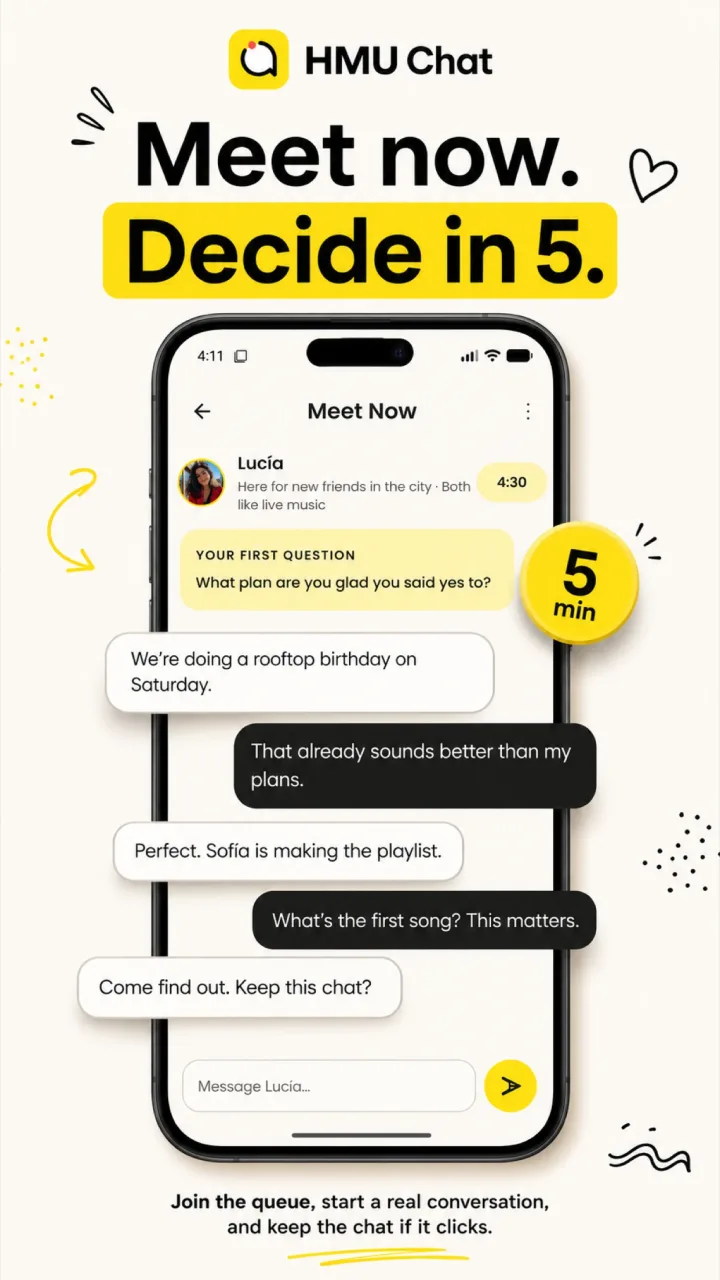
Some weeks the plans fall through. HMU is for adults 18+ who want to talk to someone new, for friendship, dating, or both. Meet Now pairs you with one person for five minutes with the same opening prompt, and you each privately choose Keep or Pass. It’s free on iPhone and Android, with 3 introductions a day.
Whatever you use, the rule is the same: when a conversation clicks, suggest a real plan before it fades.
Related articles
- Apps to Make Friends as an Adult: An Honest Comparison — BFF, Meetup, Timeleft, 222, Yubo, and HMU compared by how you actually meet people, what it costs, and who each one suits.
- How to Make Friends Online (and Turn Chat Into Friendship) — Where to make friends online, how to go from a comment to a DM to a real friendship, and the safety habits worth keeping. Practical steps and scripts.
- Free Apps to Meet New People: What’s Actually Free — Which apps let you meet people without paying, and where the free tier stops. BFF, Nextdoor, Meetup, Yubo, Hinge, Tinder and HMU, checked on their own pages.
- Is Bumble BFF Worth It? An Honest Review — In the US, BFF costs nothing, so the real cost is your time. Which BFF app you’re looking at, what you get, and a two-week test to find out if it works.