
Should you just act more outgoing?
Most friendship advice for introverts boils down to ‘push yourself.’ The research says that’s half right.
In lab studies at Carleton University, introverts who were asked to act extraverted for a short task felt more positive, and they didn’t feel worse. But a 2019 randomized trial from the University of Melbourne asked people to act extraverted for a full week of everyday life. On average, it helped. The more introverted participants, though, got smaller benefits and reported more negative feelings, more tiredness, and feeling less like themselves.
The practical takeaway: short bursts of being outgoing work for introverts. Sustained performance costs more. So design your social life around short, deliberate efforts with recovery built in.
Choose one-to-one over groups
Groups reward people who talk fast and jump in. One-to-one conversations reward listening, follow-up questions, and remembering details, which is where many introverts are strongest. You also only have to read one person.
So skip the networking mixer and invite one person to something specific. Coffee, a walk, a museum, a bookstore. Activities that give you something to look at besides each other take pressure off silence.
- ‘Want to grab coffee Saturday morning? There’s a place near the park I like.’
- ‘I’m going to the new exhibit at the museum on Sunday. Want to come?’
Pick activities with a script built in
Unstructured socializing, like a party where you’re supposed to just mingle, is the most draining format. Structured activities give everyone a role and something to talk about. A board game night, a pottery class, a volunteer shift, a climbing session, or a book club tells you what to do with your hands and your attention. Conversation happens around the activity instead of being the whole point.
The same group every week matters more than the activity itself. Repetition turns strangers into familiar faces without you having to do anything extra.
Set your exit before you arrive
A lot of introvert dread comes from not knowing when it ends. Decide in advance. Tell the host you can stay until nine. Book a 45-minute coffee before something else. Drive yourself so you can leave when you want.
Leaving while you’re still enjoying yourself is a good outcome, not a failure. People remember that you were good company, and you have energy left to say yes next time.
How to end a conversation kindly
- ‘I’ve got an early morning, so I’m heading out. Really glad I came.’
- ‘This was great. Let’s do it again next week?’
Other people are more interested than you assume
Two findings are worth keeping in mind. In experiments by Nicholas Epley and Juliana Schroeder at Chicago Booth, commuters asked to talk to a stranger on their train or bus had a better commute than those asked to sit quietly. Other commuters predicted the opposite. A big part of the mistake was underestimating how interested the stranger would be in talking.
And in the liking gap studies, people consistently underestimated how much their conversation partner liked them. The researchers think it’s because people are too busy replaying what they said to notice the other person’s signals. If you walk away from a conversation sure it went badly, it probably went better than you think.
Prepare three questions, not a personality
You don’t need small talk skills. You need a few good questions you can rely on when your mind goes blank. Choose questions that people enjoy answering and that lead to follow-ups. Then listen, and ask about the details.
More conversation starters for meeting someone new
- ‘What are you looking forward to this month?’
- ‘How did you get into that?’
- ‘What’s something you’ve changed your mind about recently?’
Short conversations with a clear end
Apps can suit introverts because you start from home and can stop whenever you want. The catch is endless small talk that never goes anywhere. Look for formats that keep it short and give you something to say.
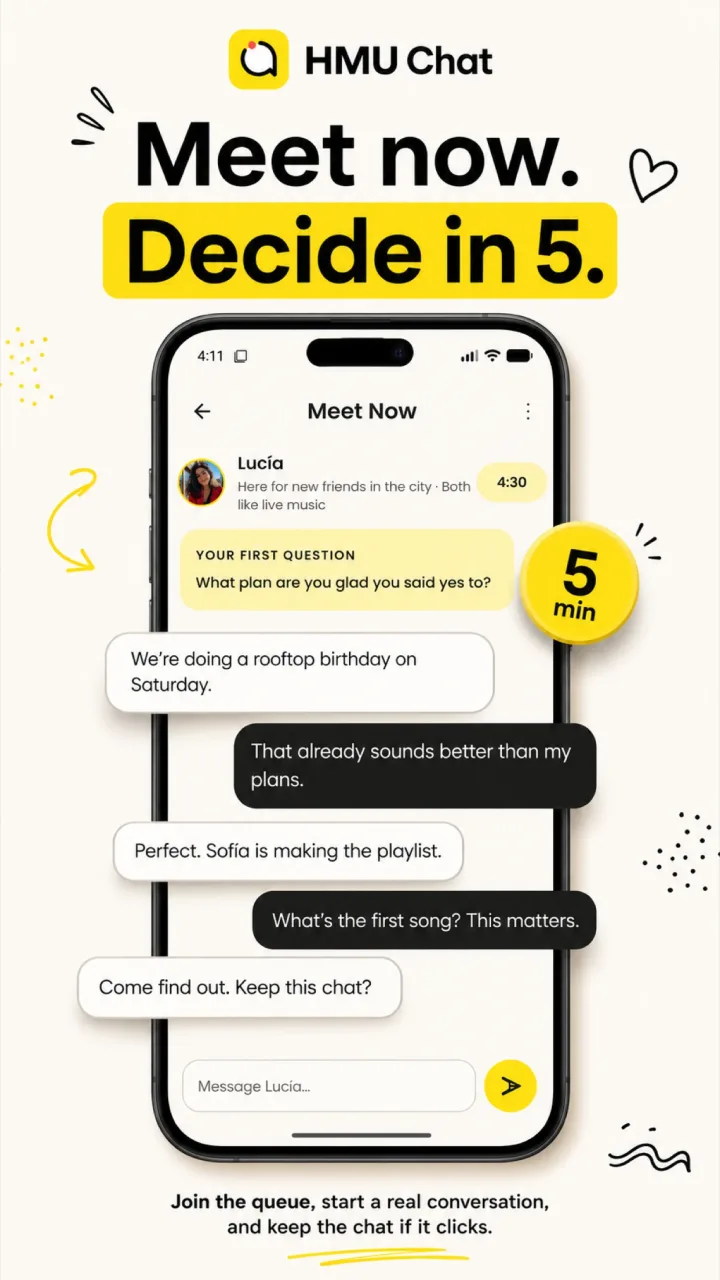
HMU’s Meet Now is built that way. It pairs you with one person and gives you both the same opening prompt, so nobody has to think of an opener. You talk for five minutes. Then each of you privately chooses Keep or Pass, and the chat continues only if you both choose Keep. It’s free for adults 18 and over, the free tier includes three Meet Now introductions a day, and you can report or block anyone.
Introversion isn’t the same as social anxiety
Introversion is about where you get your energy. You can enjoy people and still need quiet time afterward. Social anxiety is different. The National Institute of Mental Health describes social anxiety disorder as an intense fear of being judged that lasts at least six months and gets in the way of work, school, or relationships.
If fear, rather than tiredness, is what keeps you home, the advice in this article may not be enough on its own. Social anxiety disorder is treatable, usually with therapy such as cognitive behavioral therapy, medication, or both. Talking to a doctor or therapist is a strong first step toward the friendships you want.
Related articles
- Apps to Make Friends as an Adult: An Honest Comparison — BFF, Meetup, Timeleft, 222, Yubo, and HMU compared by how you actually meet people, what it costs, and who each one suits.
- How to Make Friends When You Work From Home — Remote work removed the casual contact that turns coworkers into friends. Rebuild it with a weekly routine, real scripts, and your daytime freedom.
- How to Make Friends After a Breakup: A Rebuild Plan — Drifted friends, a shared circle, empty weekends. A three-month plan to rebuild your social life after a breakup, with messages you can send today.
- How to Make Friends in a New City — A first-90-days plan for meeting people after a move: what to do in week one, which apps help, and how to turn new faces into real friends.