
Pick an interest that meets every week
Sharing an interest gets you a first conversation. It doesn’t make a friend. Communication researcher Jeffrey Hall at the University of Kansas found that people spend about 50 hours together before they call each other casual friends, about 90 hours before they’re friends, and more than 200 before they’re close. The hours that counted most were spent hanging out, not working side by side.
So the most useful filter isn’t “what am I into?” It’s “what am I into that happens every week with the same people?” A weekly run club gives you an hour or two a week with the same faces. A one-off festival gives you one afternoon with strangers you probably won’t see again. If you love something that doesn’t meet regularly, look for the recurring version of it: a league instead of a tournament, a class term instead of a workshop, a standing table instead of a convention.
Searches that find local groups
Generic searches return listicles. Specific ones return the groups that are actually meeting. Swap in your hobby and your neighborhood or town, and try a few of these:
- “[hobby] club [town]” or “[hobby] group [neighborhood]”
- “beginner [hobby] [town]” or “[hobby] drop-in [town]”. Beginner and drop-in groups expect new people.
- “[hobby] league [town] sign up” for sports, trivia and board games
- “[town] library events” and “[town] parks and recreation classes”. These are cheap or free and almost never show up in app searches.
- “[hobby] [town] Discord” or “[town] subreddit [hobby]” for groups that organize online and meet offline
Ask the shop, not the internet
The places that sell your hobby usually know who practices it nearby. Many game stores host league nights, running stores host group runs, and climbing gyms run partner meetups. Yarn shops, bike shops, bookstores and record stores often have a corkboard or a staff member who knows which club is lively and which barely meets.
One line at the counter does it: “Is there a group that plays/rides/meets here regularly? I’m new and looking for one.” You’ll get a better answer than any search result, and you’ll often get a name to ask for.
Meetup: free to join, judge the group first
Meetup is a directory of interest groups. Free members can browse groups by interest and location, join and RSVP to as many as they want, post in group discussions and message organizers. Seeing who else is attending or who is in a group needs the paid Meetup+ upgrade, so you’ll have to judge a group by its activity instead.
Before you RSVP, scroll back through past events. A good first group has met at least a few times in the last month, keeps a similar format each time, and is small enough that the organizer will notice a new face. If you’re unsure, message the organizer: “First time, coming alone. Anything I should know?” Organizers who reply quickly tend to run welcoming groups.
Volunteer around what you care about
If your interest is a cause, such as animals, trails, food access or literacy, a regular volunteer shift puts you next to the same people every week with something to talk about. VolunteerMatch is now part of Idealist, which lists onsite and virtual opportunities and lets you set a search radius as tight as five miles.
Choose a recurring shift over a one-day event, and the same day and time each week. You’ll see the same crew every time, which is exactly what one-day events don’t give you.
When your interest is too niche for a club
Some interests don’t have a local group yet: a specific video game, an obscure genre, a craft nobody near you seems to do. Here, the order flips. Find people online first, then narrow down to the ones nearby.
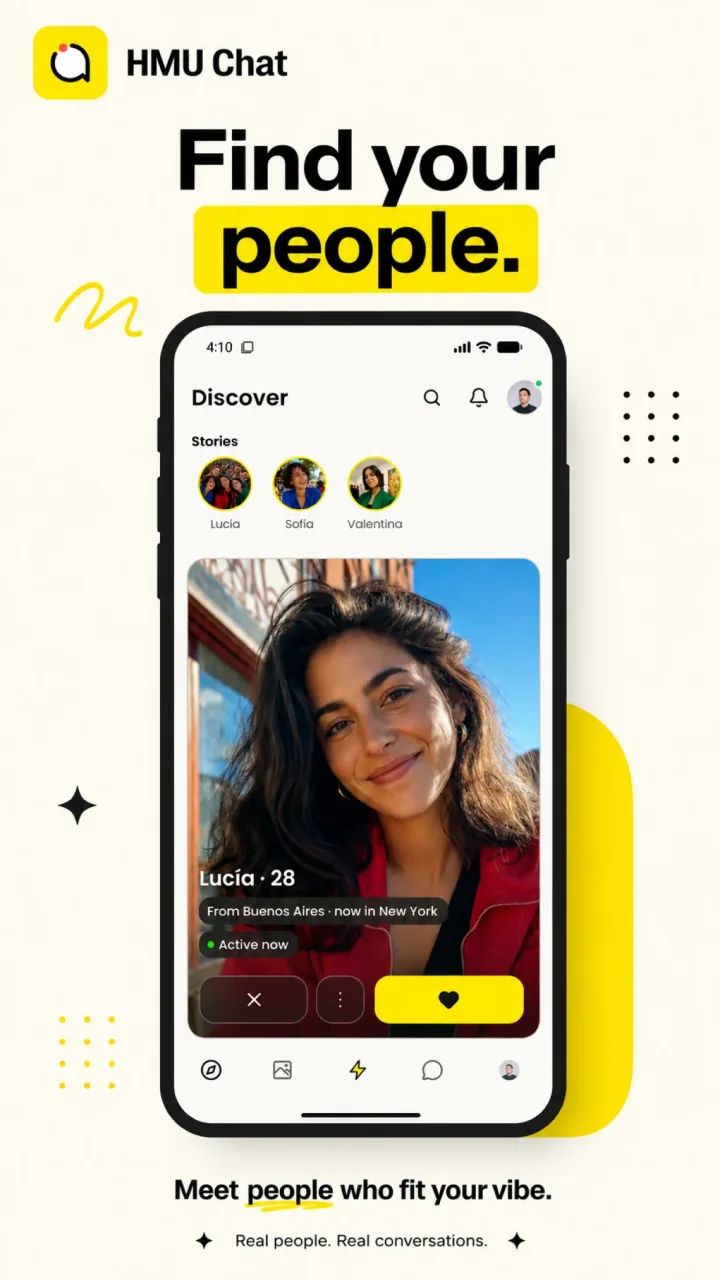
On HMU, your profile has a question to answer, and there’s a new question every day. Answer them with real specifics, like the album, the trail or the game, rather than “music, hiking, gaming”. Specifics are what make someone message you. Discover has a Nearby tab alongside For You and Recent, and you can post Moments and stories about what you’re doing. Every request on HMU starts with a real first message, so mention the shared interest in it.
Turn “we both like this” into a plan
Most shared-interest connections stall at “we should do that sometime.” Make it specific, low-cost, and tied to the interest, so saying yes is easy and saying no isn’t awkward.
How to go to a social event alone
- “There’s a beginner bouldering night Thursday at 7. Want to go? I’m bad at it too.”
- “The used bookstore on Main has a sci-fi shelf I keep meaning to raid. Saturday morning?”
- “Our team needs a fourth for trivia on Tuesday. No studying required.”
- “I’m going to the Sunday group ride again. It’s slow, if you want to try it.”
A four-week plan
Week one: run three of the searches above and ask in one shop. Make a shortlist of two groups that meet weekly. Week two: go to both, alone if you have to, and learn two names at each. Week three: go back to the one that felt better. Showing up a second time is when people start to remember you. Week four: suggest one small thing outside the group to someone you’ve talked to twice, like coffee before the next session or a ride together.
If a group doesn’t click after three visits, try the other one. Don’t give up on the interest itself.
Related articles
- How to Meet People Through Volunteering — Find a volunteer role that fits your interests and meet people naturally while contributing to a cause you care about.
- A First-Timer’s Guide to Board Game Night — Know what to expect at a board game night, how to choose a beginner-friendly table, and how to join at your own pace.
- How to Plan a First Meetup for an Online Community — Turn a shared online interest into a welcoming in-person meetup with a clear plan, privacy, safety, and no pressure to attend.
- How to Start a Neighborhood Walking Group for All Paces — Plan a friendly neighborhood walk with a clear route, flexible pace, and simple details that help first-timers feel comfortable joining.