
The real risk is money and leverage
Most of what goes wrong between adults online isn't random danger. It's someone working toward something: your money, your accounts, or a photo they can use against you. Nearly 60% of people who told the FTC they lost money to a romance scam in 2025 said it started on social media, and those social-media romance scams alone cost people $298 million.
That changes how you should think about safety. You don't need to treat every new person as a threat. You need to recognize the handful of moves that scams depend on, and refuse them every time, no matter how good the conversation has been.
Lock your accounts before you start
Your email is the key to everything else, so the UK’s National Cyber Security Centre puts it first: give it a strong password you use nowhere else, and turn on 2-step verification there and on every app where you chat. A password manager makes this painless. Discord’s safety team adds one rule that applies everywhere: no real company asks you for your password or login code in a message.
Then tighten what a stranger can see. The FTC recommends limiting who can view your posts and your contacts list. A public friends list tells a scammer exactly who to impersonate, and who to threaten.
What to keep back in the first few chats
Talk about anything you like, but keep the details that let someone find you or pressure you. Tinder’s safety guidance lists your address, your workplace and your daily routine. Add your full name and anything that shows your face alongside other identifying details. You can share all of it later with someone you’ve met and trust.
How to share your socials safely with someone new
- Say “I’m on the east side” instead of your street or building
- Say “I work in healthcare” instead of naming the hospital
- Say “I run most mornings” instead of “6am at the lake loop”
- Use a username that isn’t your handle on other apps, so one search doesn’t lead to all of them
Six lines that should end the conversation
Scams follow a script, and the FTC has published it. Any one of these is enough to stop replying. You don’t owe anyone an explanation, and polished writing proves nothing. CISA points out that AI can produce perfect grammar, so stop relying on typos to spot fakes.
- “Let’s move to WhatsApp, I’m barely on here.” Pushing you off the app early is the first warning sign on the FTC’s list.
- “I’ve never felt this way about anyone.” Said within days, by someone you’ve never seen on video.
- “I’m on an oil rig / deployed / working overseas, so I can’t meet yet.”
- “I’ll show you how I made money on crypto.” The FTC’s advice: never let someone you met online direct your investments.
- “Can you help with a hospital bill / plane ticket / customs fee? I’ll pay you back.” Especially if they want gift cards, a wire, an app transfer or crypto.
- “Send me a photo right now, I’ll delete it.” Urgency around images is a warning sign, according to the FBI.
Check that they’re real, in under five minutes
Run their profile photo through a reverse image search. On a computer, drop it into Google’s Search by image. In Chrome, right-click a photo and choose Search with Google Lens. If the same face shows up under another name, a modeling portfolio or a stock photo site, you have your answer. The FTC also suggests searching the job they claim plus the word “scammer”, because the same cover stories get reused.
Then ask for a short video call before you invest more time or meet. Tinder’s safety guidance recommends a phone or video call before meeting. Someone real can usually manage two minutes on camera this week. Someone who always has a broken camera, a bad connection or a reason to wait is telling you something.
If someone threatens to share images
This is sextortion, and the FBI says it affects adults too, including people whose ordinary photos were turned into fake explicit images with AI. Don’t pay and don’t send more. The FBI warns that doing what they ask doesn’t guarantee the images stay private.
Stop replying, but don’t delete the chat first. Screenshot their username, profile, the platform you were on and the messages, then report the account on that platform and file a report at ic3.gov. Tell one person you trust. It feels humiliating, but you are the one being targeted for a crime.
If you already sent money
Act right away. Call your bank, or the gift card company, wire service or crypto exchange you used, tell them it was a scam and ask for a refund. Report it to the FTC at ReportFraud.ftc.gov and to the app where you met. Then stop all contact.
Meeting in person, when you’re ready
Meet somewhere public and stay somewhere public. Tell a friend who you’re meeting, where and when, and arrange your own way there and back so you can leave whenever you want. A coffee with a clear end time is a better first meeting than dinner and drinks.
How this works on HMU
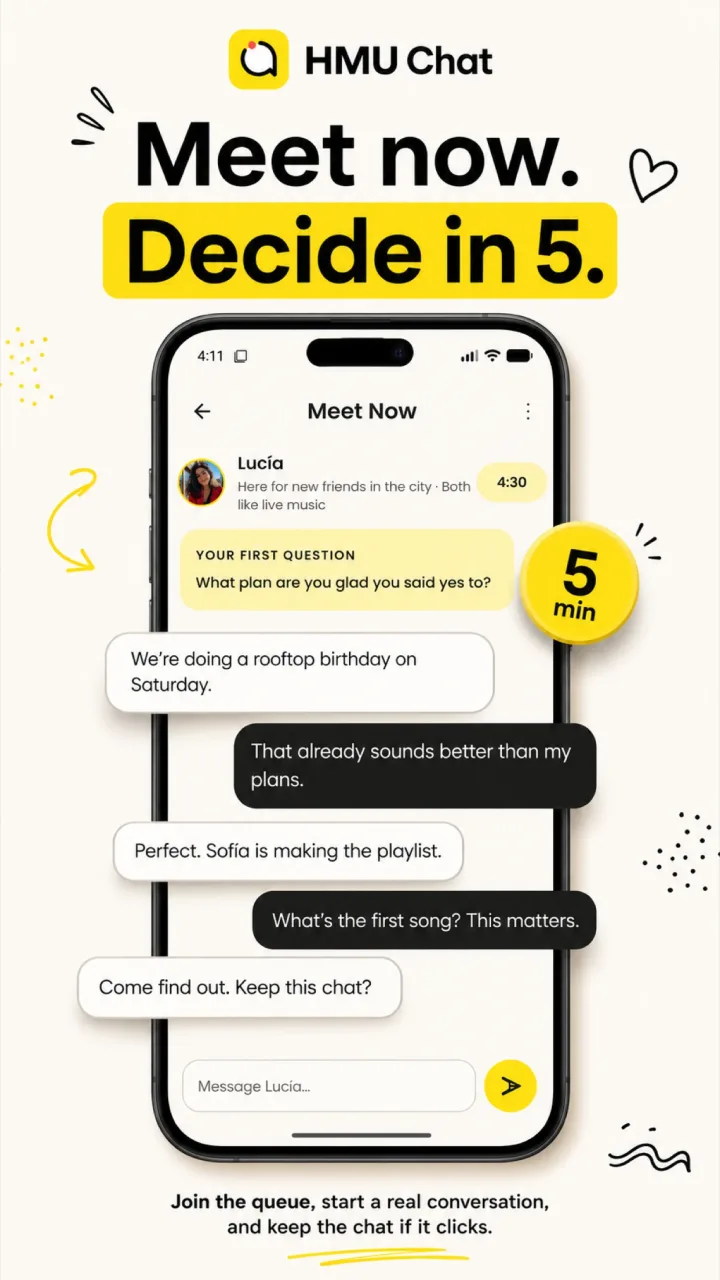
HMU is for adults 18 and over, and the same rules apply there as anywhere else. Keep the conversation in the app while you get to know someone. In Meet Now you talk with one person for five minutes, starting from the same prompt, and the chat continues only if you both privately choose Keep. If you choose Pass, it ends there.
You can report or block anyone on HMU, at any point. Use it the moment someone asks for money, pushes you to another app, or ignores a no. You don’t need to be sure it’s a scam first.
Related articles
- Healthy Boundaries When Meeting People Online — Protect your time, privacy, and comfort while getting to know someone through online conversations.
- Before You Share Your Social Media With Someone New — Decide what a new connection can see before you exchange social accounts, and keep control of how quickly the conversation moves.
- Ask Before You Post a Photo of Friends — A quick consent check lets friends choose whether their face, name, location, or moment appears online.
- Who Pays Doesn’t Decide What Happens After the Date — Discuss a date’s cost and bill clearly, accept or decline an offer to pay, and keep affection, another date, and consent separate from the receipt.